My favorite Frank Black song maybe. Live.
Showing posts with label Space. Show all posts
Showing posts with label Space. Show all posts
7.17.2010


6.15.2010

6.08.2010
Welcome to the future
In New Space Race, Enter the Entrepreneurs


Four years from now, the company plans for real modules to be launched and assembled into the solar system’s first private space station. Paying customers — primarily nations that do not have the money or expertise to build a space program from scratch — would arrive a year later.

IN THE FUTURE Prototypes of Bigelow Aerospace’s Sundancer habitat, which has an inflated volume of 180 cubic meters, at a hangar in North Las Vegas.

6.07.2010
There's Always the Sun
As the Sun Awakens, NASA Keeps a Wary Eye on Space Weather

I believe we're on the threshold of a new era in which space weather can be as influential in our daily lives as ordinary terrestrial weather.
--Richard Fisher, head of NASA's Heliophysics Division

4.16.2010
Not That Bad Really
So we aren't going back to the moon--which is disappointing--but we are now shooting for something much more difficult and way more scientifically interesting: an asteroid. And Mars is still a national priority.
I like Obama's program for NASA for 4 reasons:
"Go ahead and land your people on the moon China...we went there decades ago. And try not to choke on our fumes as we land people on an asteroid and collect data that could save humankind."
How much you want to bet that as we get closer to landing Americans on an asteroid, the Chinese become less interested in landing their people on the moon?
I like Obama's program for NASA for 4 reasons:
- It's fiscally doable, as necessity can be defended via planetary security. Bush the Younger proposed a moon mission, then poorly funded the endeavor so that the next administration could take the hit for cancelling it. Thanks Bin Laden....This mission transcends Chinese bombastics and national apathy: we Americans will provide the world with the data necessary to defend our planet from asteroids.
- It, through an outer-terrestrial manned mission, sets up the engineering and national excitement for the longer, more exciting Mars mission.
- It focuses on heavy lifting, which will be required for all of our serious robotic explorations (the overdue replacement for the Hubble, a Europa probe, etc).
- It, through out-sourcing near-earth orbit duties to civilian and international space agencies, allows the NASA budget to be spent mostly on what it should: science.
"Go ahead and land your people on the moon China...we went there decades ago. And try not to choke on our fumes as we land people on an asteroid and collect data that could save humankind."
How much you want to bet that as we get closer to landing Americans on an asteroid, the Chinese become less interested in landing their people on the moon?
3.08.2010
1.30.2010
A Scientific Response To The Cancellation Of NASA's Constellation Program
I agree entirely. To quote the great Daniel Burnham: make no small plans.
Bush made lots of expensive (and questionable) small plans regarding space exploration, and his administration was apt at spinning them as a great big plan (a great big plan that was never, in any way, funded to its necessity).
In reality, all that happened was nothing, save the expansion of the quasi-inspiring ISS (neither a space port nor a cost-effective scientific outpost) and the Hubble repair mission. And even the magnificently executed and scientifically invaluable latter, when one ponders it, is a failure to replace a great scientific resource with a better one. For over a decade, our government has failed to invest in a reasonable advancement over the space shuttles. Their proposed threadbare replacement, an over-glorified Saturn V rocket, inspires about as much awe as it does confidence.
NASA can do better; NASA will do better.
Bush made lots of expensive (and questionable) small plans regarding space exploration, and his administration was apt at spinning them as a great big plan (a great big plan that was never, in any way, funded to its necessity).
In reality, all that happened was nothing, save the expansion of the quasi-inspiring ISS (neither a space port nor a cost-effective scientific outpost) and the Hubble repair mission. And even the magnificently executed and scientifically invaluable latter, when one ponders it, is a failure to replace a great scientific resource with a better one. For over a decade, our government has failed to invest in a reasonable advancement over the space shuttles. Their proposed threadbare replacement, an over-glorified Saturn V rocket, inspires about as much awe as it does confidence.
NASA can do better; NASA will do better.
1.27.2010
Amateur Hour: Worse Than I Thought
Despite my Libertarian beliefs, I was happy enough to believe that a tax & spend President could at least fund something worthwhile. Short of removing all tax barriers for private space exploration (which no Congressman/woman will ever do), at least government could pave the way. Or so I thought.
from the Orlando Sentinel:
Obama aims to ax moon mission
from the Orlando Sentinel:
Obama aims to ax moon mission
NASA's plans to return astronauts to the moon are dead. So are the rockets being designed to take them there — that is, if President Barack Obama gets his way.
When the White House releases his budget proposal Monday, there will be no money for the Constellation program that was supposed to return humans to the moon by 2020. The troubled and expensive Ares I rocket that was to replace the space shuttle to ferry humans to space will be gone, along with money for its bigger brother, the Ares V cargo rocket that was to launch the fuel and supplies needed to take humans back to the moon.
There will be no lunar landers, no moon bases, no Constellation program at all.
In their place, according to White House insiders, agency officials, industry executives and congressional sources familiar with Obama's long-awaited plans for the space agency, NASA will look at developing a new "heavy-lift" rocket that one day will take humans and robots to explore beyond low Earth orbit. But that day will be years — possibly even a decade or more — away.
In the meantime, the White House will direct NASA to concentrate on Earth-science projects — principally, researching and monitoring climate change — and on a new technology research and development program that will one day make human exploration of asteroids and the inner solar system possible.

8.18.2009
Carl Sagan was right ...
... we are "star stuff".

Building block of life found on comet
LOS ANGELES (Reuters) - The amino acid glycine, a fundamental building block of proteins, has been found in a comet for the first time, bolstering the theory that raw ingredients of life arrived on Earth from outer space, scientists said on Monday.
Microscopic traces of glycine were discovered in a sample of particles retrieved from the tail of comet Wild 2 by the NASA spacecraft Stardust deep in the solar system some 242 million miles (390 million km) from Earth, in January 2004.
Samples of gas and dust collected on a small dish lined with a super-fluffy material called aerogel were returned to Earth two years later in a canister that detached from the spacecraft and landed by parachute in the Utah desert.
5.24.2009
Atlantis Returns Safely

After an extremely dangerous mission, space shuttle Atlantis has returned safely. I can't wait to see the results of their worth-while mission.
5.15.2009
Continued Successes
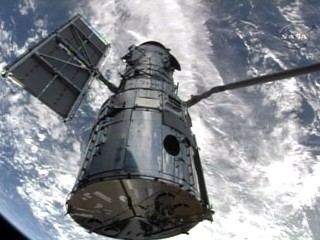
 The Hubble repairs are going forward. Two down, three to go...
Meanwhile, the ESA's Herschel and Planck are on their way to their off-Terran orbits. We will learn a lot from them.
5.13.2009
5.12.2009
Godspeed, You Magnificent Champions Of Science

Space shuttle Atlantis is up and about to begin a very dangerous but worthy mission: to keep the Hubble Space Telescope operational until it can be replaced.
Prayers for their mission and crew would seem so crude given what they are tasked to do and why we hope they succeed. So I will watch with wonder and hope, putting my trust in their expertise and bravery--and with the intelligence and ingenuity of those on the ground--rather than in supplications and rituals. That trust is well-placed, as the former gave us this:

While the latter, this:
 But in keeping with naval tradition, I say godspeed, you magnificent champions of science.
4.13.2009
3.14.2009
AKA: Waterbears

Tardigrades In Space or "TARDIS" is the first research project to evaluate the ability of tardigrades to survive under open space conditions. TARDIS is one of the projects within the Biopan-6 research platform provided by European Space Agency (ESA), and will be sent into space with the russian FOTON-M3 mission.
Tardigrades Goldstein Lab, UNC, Chapel Hill

2.06.2009
"The Future of Terrorism"
Iran's New Satellites: The Pasdaran in Space
Walid Phares

Walid Phares
The Associated Press revealed to the world Tuesday that "according to Tehran, Iran has successfully sent its first domestically made satellite into orbit, as announced by Mahmoud Ahmadinejad." But while the Iranian President claimed the move was to develop "science for friendship, brotherhood and justice," AP noted this was "a significant step in an ambitious space program that has worried many international observers."
1.22.2009
NASA Is Already Getting Gear Ready To Analyze Those Martian Farts

Science (potentially) can determine whether methane is biogenic or abiogenic. Already work is being done towards getting an instrument on Mars that can make that determination.
While its readings wouldn't be conclusive, they would be highly suggestive. Suggestive enough, let's hope, to convince the world that Mars should be explored more thoroughly (ie, by humans).
11.20.2008

Subscribe to:
Posts (Atom)
